


The consensus read on the US diesel crack spread breaking $100 a barrel is that this is a supply shock story. It is, but only partly. The more uncomfortable read is that the emergency buffers designed to absorb exactly this kind of shock have already been spent, leaving the market structurally exposed in a way that distinguishes the current episode from every previous spike.
A Record That Rewrites the Map
The US diesel crack spread, the premium of ultra-low sulphur diesel futures over West Texas Intermediate crude, hit an all-time high of $102.20 a barrel on Monday. By 11:56am ET it had pulled back slightly to $99.82, still up 2.4% from Friday. The spread has set new intraday records in five of the last six sessions. To put the velocity in context: on 5 August the crack was a relatively elevated $80.47 per barrel. By 14 August it had vaulted to $101.17. By 17 August it had reached $101.85, driven by a widening gap between landlocked WTI crude at $85.01 a barrel and wholesale refined diesel at $4.449 per gallon.
Under normal conditions, crack spreads sit in the teens or low twenties. The current level is not a stress test of the system. It is a verdict on it.
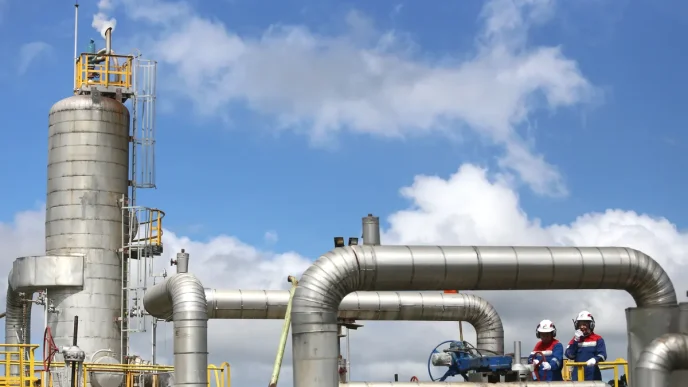
The International Energy Agency said in a monthly report that global refinery crude throughput averaged 80.9 million barrels per day in July, down roughly 5 million barrels per day from a year earlier. Wars in Iran and Ukraine have physically knocked out critical processing infrastructure: airstrikes and counter-attacks have damaged major refineries throughout the Persian Gulf, while Ukrainian drone strikes have taken out Russian refinery hubs. Estimates put roughly 40% of Russia’s domestic refining capacity offline. Because Russia was previously shipping over 1 million barrels of diesel daily, the export halt forced the US and Europe to scramble for supply.
The arithmetic consequence is a crude-versus-product disconnect that most coverage underweights. Raw crude cannot power a tractor or a cargo ship. It must pass through a refinery first. With so much refining capacity offline, crude is artificially cheap relative to the fuel it produces. Finished diesel, scarce and immediately usable, commands an astronomical scarcity premium. The crack spread is simply pricing that bottleneck.
The SPR Is Not the Backstop It Appears
Here is where the popular narrative becomes genuinely misleading. The Strategic Petroleum Reserve (SPR) is routinely cited as the government’s tool of last resort. What is less widely understood is how depleted and operationally constrained that reserve now is.
According to the Bipartisan Policy Center, the reserve held 308 million barrels as of 24 July 2026, its lowest level since 1983. Two successive large-scale drawdowns explain much of the depletion: the Biden administration ordered the release of 180 million barrels as the war disrupted Russian oil flows, and the Trump administration subsequently ordered a further release of 172 million barrels following the closure of the Strait of Hormuz. The cumulative drain has left the reserve at a structural low.
The operational picture is worse still. In May, the Government Accountability Office warned that more than a quarter of the reserve’s inventory was not available for drawdown due to outages, according to CNBC. If a meaningful fraction of what remains on paper cannot actually be extracted, the effective buffer is smaller than the headline figure implies. The SPR, in short, is doing a fine impression of a safety net that has already been cut to ribbons.
US diesel inventories have compounded the problem. They have plummeted to roughly 10-12% below multi-year averages, leaving, as the report’s own characterisation puts it, zero room for error. According to the US Energy Information Administration, diesel is the fuel underpinning commercial trucking, rail, shipping and agricultural equipment, meaning the inventory deficit is not abstract.
Farmers and Truckers Bear Different Wounds
The immediate human cost lands asymmetrically. For large trucking carriers, fuel surcharges allow higher costs to be passed through to shippers and, ultimately, consumers, fuelling broader inflation. Independent owner-operators on fixed-rate spot contracts have no such mechanism. When the crack spread spikes, their margins disappear and many face the choice of parking their rigs or insolvency.
For farmers, the calculus is structurally harsher. Unlike truckers, they are price-takers. A corn or soybean grower cannot demand a fuel surcharge from a grain elevator. Diesel is a large upfront capital investment consumed in concentrated windows, spring planting and autumn harvest, with no flexibility. Buying fuel in bulk months in advance locks in input costs; if crop prices fall by harvest, high costs and low revenue arrive simultaneously. The national average for retail diesel reached $5.445 per gallon on 17 August, according to AAA Fuel Prices data, less than 40 cents below the all-time record of $5.816 set in June 2022. Unlike 2022, the current spike is occurring with an SPR at a 40-year low and global refining capacity already crippled.
The GAO’s May warning, the scale of the successive SPR drawdowns, and the 80.9 million barrels per day IEA throughput figure together point to the same conclusion: the structural deficit in downstream capacity is not a temporary dislocation to be managed with emergency releases. The releases are done. The harvest season is not.