


Unlike the rest of Greece, Corfu never fell under Ottoman rule. Four centuries of Venetian rule shaped its Italianate architecture and narrow kantounia alleys, French administration added the Parisian-style Liston in the early 1800s, and British rule layered on the neoclassical Palace of St. Michael and St. George. Locals know how to use the resulting UNESCO Old Town. Most visitors leave half of it untouched.
The notes below favour the version Corfiots actually move through. Same town, different rhythm.
How to move through the Old Town
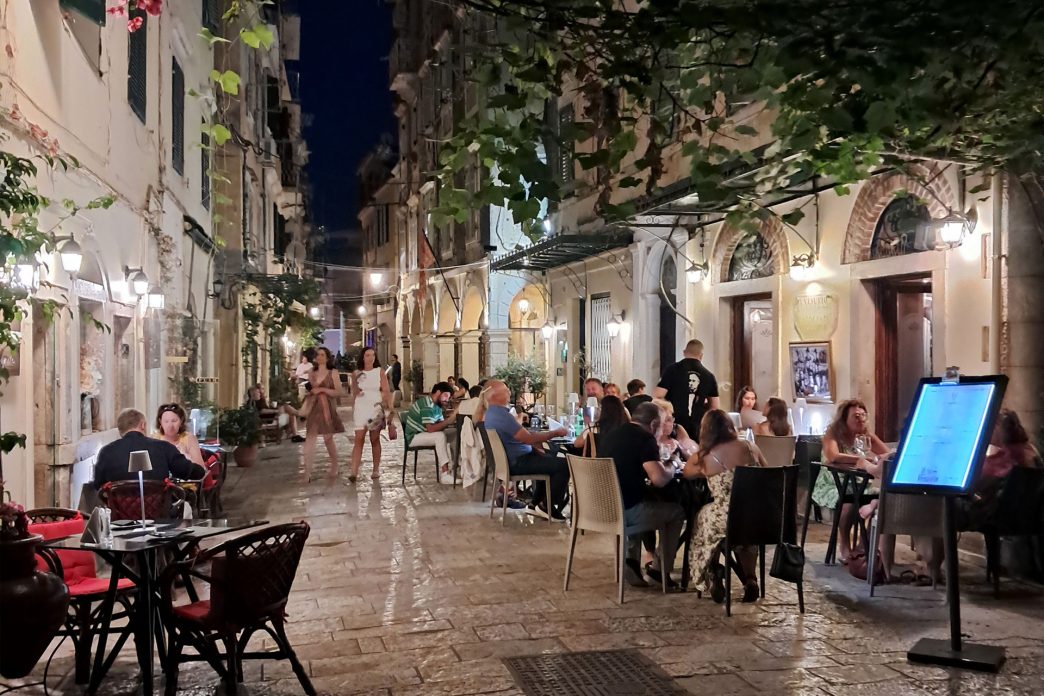
Arriving by car at 9:00 AM avoids the mid-morning crowd and the parking pressure. Two large lots sit roughly ten minutes from the centre on foot, which is how to enter the historic district properly. The sea wraps the Old Town on most sides, which makes the local advice safe to follow: get lost in the kantounia parallel to the main routes, and the coastline will orient anyone back.
The Liston colonnade, built during French occupation between 1807 and 1814, is the place to take a coffee and watch the cricket on Spianada Square. Both Liston and Kohlias work for a table under the arches.
Summer humidity is real, and locals pace the day in town with hydration breaks on Spianada’s shaded benches or over a coffee at the Liston.
The buildings worth the climb, and the one to skip in July
The Old Fortress earns its visit for the lighthouse view and the British-built Church of Saint George inside. The New Fortress, on the opposite side of the Old Town, offers the better photograph: an elevated angle over the terracotta rooftops, taken from sturdy 16th-century masonry.
The Holy Church of Saint Spyridon houses the relics of the city’s patron saint and dominates the skyline with its Venetian-style bell tower. The Corfu Museum of Asian Art, set inside the Palace of St. Michael and St. George, holds over 15,000 artifacts from the Far East and India, which is unusual for a Greek island museum.
Further afield, the Achilleion Palace near Gastouri was commissioned in 1890 by Empress Elisabeth of Austria, who built it around her obsession with the myths of Achilles. The Holy Monastery of Panagia Vlacherna at Kanoni, on its tiny causeway-linked islet, is one of the most photographed spots in Greece.
The one to skip in peak season, according to local consensus, is Canal d’Amour in Sidari. The rock formations are real, but the crowds and the surrounding development outweigh the visit during July and August. Off-peak it is a different conversation.
Where Corfiots eat and drink
Rex, on Kapodistriou Street just behind the Liston, has been serving classic Greek cuisine since 1932. Aegli has held its spot on the Liston colonnade for over forty years. Both are obvious only if a visitor already knows to look behind the arches rather than at them.
For quieter neighbourhood dinners, the Ovriaki backstreets hold Ampakas, a small kitchen serving authentic Greek dishes in one of the quieter lanes of the centre. Pomo d’Oro in Skaramangas Square is the upscale Corfiot choice, with traditional recipes reworked through modern technique. The Venetian Well in Kremasti Square is the contemporary fine-dining option in a historic setting that most travel pieces lead with.
Coffee in town has a proper specialty layer. Cafetierra and its sister Plakado, both near Spianada, are the local artisanal espresso bars and the physical home of the roastery’s blends. Stazei meli, near Town Hall Square, is famous for loukoumades, the traditional honey dumplings, and is the right stop for a sit-down sweet break. Papagiorgis gelateria, a century-old family business near the Liston, holds the line on kumquat ice cream and mandolato.
The edible souvenirs and shops worth the walk
The Dionysios Skiadopoulos Pharmacy preserves the recipe for Spetsieriko, a traditional spice mix of over a dozen ingredients used by Corfiots for generations to flavour stews like pastitsada. Stock is limited and the pharmacy typically caps sales at two packets per customer when it is available.
Patounis soap shop, in business since 1850 and now run by the fifth generation, is UNESCO-recognised for continuing hand-stamping and traditional production. Markosian coffees, since 1908, fills its corner of the historic district with the scent of freshly ground Greek coffee. Salty bag handcrafts unique travel bags from upcycled sails, which suits the visitor who wants a souvenir with a story.
Plous bookshop, with its hidden courtyard inside a historic mansion, is the place to spend an hour with a coffee and a book away from the foot traffic on the main routes.
How regulars base the trip
The smarter pattern that returning visitors use is to base in the north and treat Corfu Town as a forty-minute drive. The northern hillside villages around Vasilika Peritheia trade the density of the town for olive country, sea-and-mountain views, and short drives to the swimming coves. Ionian Stone luxury villas in Corfu sit on this northern hillside and rent either individually for up to eight guests or together as a full estate for sixteen. The configuration handles family groups and multi-generational stays without the compromises of two hotel suites, which is the booking pattern returning visitors to the north tend to prefer.
Corfu Town rewards repeat visits. The kantounia, the Spetsieriko, and the Plous courtyard tend to wait for the second.