




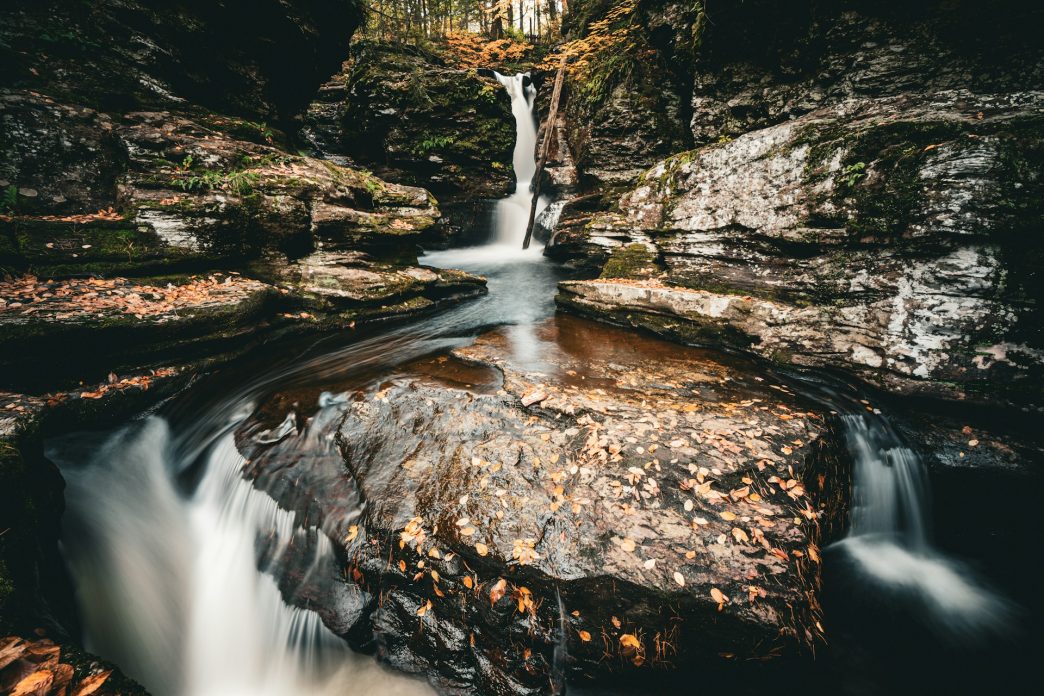
One of the most rewarding aspects of hiking and camping in Pennsylvania for Andrew Schry is gaining a deeper appreciation of the geologic forces that shaped the state’s mountains, rivers, and valleys. These landscapes not only present physical challenges on the trail but also offer a window into hundreds of millions of years of Earth’s history.
Evidence of that history can be seen in places such as Tyler State Park in Bucks County. There, exposures of the Triassic-age Stockton Formation contain fossilized plants and pollen that have helped geologists better understand ancient ecosystems and refine estimates of regional bedrock age. Such discoveries demonstrate that Pennsylvania’s landscape is the product of repeated cycles of deposition, uplift, erosion, and collision.
The story begins more than 500 million years ago, when much of what is now Pennsylvania lay beneath a shallow ocean known as the Iapetus Ocean. During the Cambrian Period (beginning around 541 million years ago), marine life diversified dramatically in what is called the Cambrian Explosion. This evolutionary burst produced many of the foundational body plans seen in modern marine organisms, including early arthropods, mollusks, and primitive vertebrates. At this time, life was still confined largely to the seas.
As marine sediments accumulated on the ocean floor, tectonic activity gradually reshaped the region. During the Ordovician Period, a volcanic island arc collided with the eastern edge of ancestral North America in an event known as the Taconic Orogeny. This collision uplifted mountains and generated extensive volcanic activity. Over time, erosion wore down these mountains, depositing sediments westward into adjacent basins.
The Late Ordovician mass extinction, approximately 444 million years ago, is believed to have been triggered in part by global cooling and glaciation, possibly linked to atmospheric carbon dioxide drawdown from enhanced weathering of newly formed mountain ranges. This event eliminated a significant percentage of marine species but also reshaped ecosystems.
Mountain-building did not occur just once. Around 400 to 380 million years ago, during the Devonian Period, another tectonic collision—the Acadian Orogeny—further uplifted eastern North America. Rivers carried sediment westward from these mountains, creating thick deposits that now form part of Pennsylvania’s bedrock. It was during the Devonian that the Marcellus Shale formed in a deep marine environment. Rich in organic material, this black shale unit later became one of the most significant natural gas reservoirs in the United States.
The Carboniferous Period (roughly 359 to 299 million years ago) marked another transformative chapter. Pennsylvania’s climate was warm and humid, supporting vast swamp forests filled with tree ferns, lycopsids, and early seed plants. Over time, layers of plant material accumulated in low-lying wetlands. Buried beneath sediments and subjected to pressure and heat, these deposits eventually transformed into the coal seams that fueled Pennsylvania’s industrial growth centuries later.
The final major mountain-building event that shaped the region was the Alleghanian Orogeny, beginning around 325 million years ago and continuing into the Permian Period. This collision between ancestral North America and Africa assembled the supercontinent Pangaea and created a massive mountain range comparable in scale to today’s Himalayas. The Appalachian Mountains are the eroded remnants of those once-towering peaks.
Since that time, erosion has been the dominant force sculpting the landscape. Rivers carved valleys, glaciers reshaped northern portions of the state during the Ice Age, and sedimentary layers were exposed and weathered. The coal seams formed in ancient swamps were uplifted and folded. The Marcellus Shale, once buried deep beneath an ancient sea, now lies thousands of feet below parts of western Pennsylvania.
For outdoor enthusiasts like Andrew Schry, the ridgelines and rock outcrops encountered on the trail are not merely scenic backdrops. They represent chapters in a story spanning half a billion years—oceans advancing and retreating, continents colliding, climates shifting, and ecosystems rising and falling. Pennsylvania’s mountains may appear ancient and unchanging, but they are the product of dynamic geologic processes that continue to shape the Earth today.