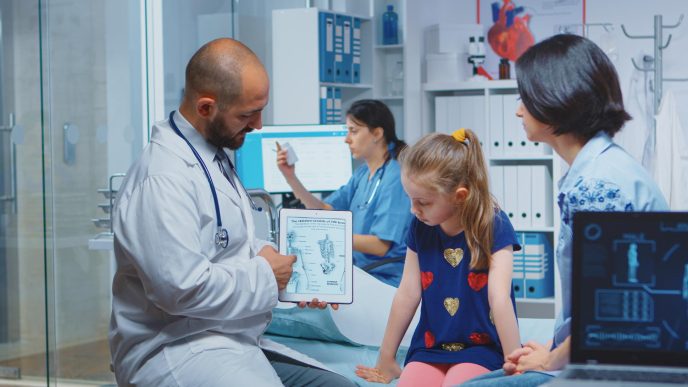





Universities from Boston to San Antonio are radically rethinking medical education, with artificial intelligence emerging as a key component of contemporary medicine. Despite its ambition, this change feels incredibly long overdue. The clinical environment has changed more quickly than academic reform, despite medical education’s decades-long reliance on strict frameworks that valued memorizing over reasoning. With its accuracy and flexibility, AI is currently accomplishing what antiquated technologies were unable to: upgrading clinical procedures and changing the perspective of aspiring doctors.
Students at the School of Medicine at George Washington University can engage with artificial intelligence (AI) tools that mimic actual clinical situations. With algorithmic support, they may assess lab options, request differential diagnoses, and create treatment regimens. These simulations are quite effective because they combine data-driven insights with human judgment. The objective is refinement rather than replacement, as Dr. Ioannis Koutroulis explains: “AI helps students think faster, but more importantly, it teaches them to think deeper.” Students gain analytical resilience—the capacity to challenge, confirm, and adjust—by collaborating with intelligent systems.
| Detail | Description |
|---|---|
| Focus Area | Integration of Artificial Intelligence to modernize medical education and clinical training |
| Key Institutions | Harvard Medical School, Stanford University, George Washington University, University of Virginia, Mount Sinai School of Medicine |
| Core Objective | Modernize outdated clinical pathways through AI-driven learning, diagnostics, and ethics training |
| Leading Figures | Dr. Jonathan H. Chen (Stanford), Dr. Ioannis Koutroulis (GW), Dr. Arjun Manrai (Harvard), Dr. Andrew Parsons (UVA), Dr. Verity Schaye (NYU) |
| Societal Impact | Preparing physicians for AI-integrated healthcare and ensuring ethical, human-centered practice |
| Authentic Source | Association of American Medical Colleges (AAMC) – Medical Schools Move from Worrying About AI to Teaching It |
Harvard Medical School has adopted a very creative strategy. Through its Computationally Enabled Medicine course, students can investigate how AI analyzes epidemiological and genetic data. They examine patterns rather than memorizing sequences. Dr. Arjun Manrai highlights that knowledge of algorithms is now just as important as knowledge of anatomy. He claims that because the medical field is becoming more and more computerized, “the new physician must be data-literate.” In a time when computers can process patient histories more quickly than entire clinical teams, his statement seems particularly pertinent.
Long recognized as a breeding ground for medical innovation, Stanford University has made AI literacy a must for graduation. One of the top experts in the field, Dr. Jonathan Chen, calls the shift a cultural reset. He remembers that “half the doctors I spoke to in 2023 didn’t know what a chatbot was.” “Our pupils are now taught how to use these systems sensibly and morally.” The shift is especially helpful since it closes the increasing gap between medical empathy and technology, enabling the next generation to use both.
In the meantime, the diagnostic exercises at the University of Virginia School of Medicine have changed. In small-group conversations, students generate their own clinical judgments first, and then they encourage AI systems to follow suit. They learn to identify bias, challenge overconfidence, and appreciate nuance by comparing the two outcomes and analyzing alignment and disparity. The initiative’s leader, Dr. Andrew Parsons, refers to it as “collaborative cognition.” According to him, “students must learn when to trust their gut and when to trust an algorithm.” This hybrid reasoning is a type of digital intuition, which will probably characterize doctors in the twenty-first century.
The integration at the Icahn School of Medicine at Mount Sinai feels particularly futuristic. A customized academic version of OpenAI’s model, ChatGPT Edu, is made available to all students. They can arrange clinical trials, create patient education materials, and summarize studies with its assistance. However, the program’s philosophy is still quite humanistic: AI is utilized to enhance care rather than automate it. One faculty member said, “You can’t automate compassion.” “However, you can make time to practice it.” That statement encapsulates the philosophical core of medical AI teaching, which is a collaboration between accuracy and compassion.
The disparity between professor familiarity and student fluency has grown to be a significant issue for all schools. While many academics are still wary, if not skeptical, about AI tools, younger students are naturally at ease with them. The discrepancy is openly acknowledged by Dr. Verity Schaye of NYU Grossman School of Medicine, who states: “Our students understand AI better than we do.” Training for faculty is now required. The school has responded quickly. These days, workshops advise teachers on how to activate AI, assess accuracy, and integrate technology into their lesson plans. To keep the classroom ahead of the clinic, this faculty recalibration is very important.
Dr. Holly Caretta-Weyer of Stanford highlights overreliance as another urgent problem. She cautions, “We cannot allow students to surrender their reasoning to a machine.” Stanford uses the DEFT-AI model—Diagnosis, Evidence, Feedback, Teaching, and AI engagement—which is intended to foster disciplined inquiry in order to address this. Students improve their judgment by examining the areas where algorithms make mistakes. It’s a surprisingly successful strategy for converting technology uncertainty into a learning opportunity.
This change is “reinvention, not replacement,” according to the National Institutes of Health. The agency encouraged colleges to develop courses that emphasize AI literacy, ethical reasoning, and bias evaluation in a historic 2025 study written by Neil Mehta. Mehta warned that if this work is put off, “non-clinical entities may gain control of medicine’s digital future.” The caution is resonant. The ethical foundation in education must endure while private AI companies gain power, guaranteeing that patient care is never reduced to a formula.
AI’s advantages for clinical learning are already apparent. Individual shortcomings are identified via adaptive learning systems, which offer real-time feedback that significantly improves retention. AI-powered diagnostic simulations expose trainees to a variety of patient profiles that are frequently missed in traditional teaching. This inclusive strategy, which is based on data diversity, is especially helpful in reducing healthcare disparities since it teaches aspiring medical professionals how to identify and reduce bias in the provision of care.
The change from passive memory to active reasoning, however, may offer the most obvious benefit. Students now question information rather than just absorbing it. They challenge models, examine outputs, and deepen their own understanding. In this way, AI deepens rather than simplifies medicine. Universities are developing physicians who can handle complexity and uncertainty by making students consider the methods they use to derive conclusions.
The impact on society is substantial. Future medical professionals will introduce AI literacy to clinics, hospitals, and policy boards as they become proficient with these tools. This new generation will create algorithms, protect ethics, and influence legislation. The approach is especially encouraging because it suggests that the next big advancement in medicine might not come from technology per se, but rather from people who learn how to use it responsibly.
Even cultural icons are being discussed in relation to AI’s potential in healthcare. Elon Musk cautions against mindless dependence, while Bill Gates refers to AI as “the most powerful medical instrument since the microscope.” The scholarly consensus falls somewhere in the middle: AI should enhance human capabilities rather than replace them. Hence, universities are serving as both educators and stewards of that equilibrium, making sure that advancement stays focused on people.
The spirit is similar to a scientific renaissance on campuses. Professors refer to their AI courses as “essential,” institutions see them as “urgent,” and students characterize them as “transformative.” It is widely acknowledged that the future of medicine depends on training individuals who can effectively lead those programs rather than replacing people with programs.
By using AI to update antiquated clinical pathways, academic institutions are not only imparting new knowledge but also changing the course of medical education. They are creating doctors who act compassionately while thinking algorithmically—doctors who view data as a collaborator rather than a danger. The algorithm may soon follow in the stethoscope’s footsteps as a sign of medical expertise. And under the direction of astute educators, that evolution is not only unavoidable but also incredibly promising.